

New Government-Backed Apprenticeship Units Now Available: Power Your Career with High Ridge Training
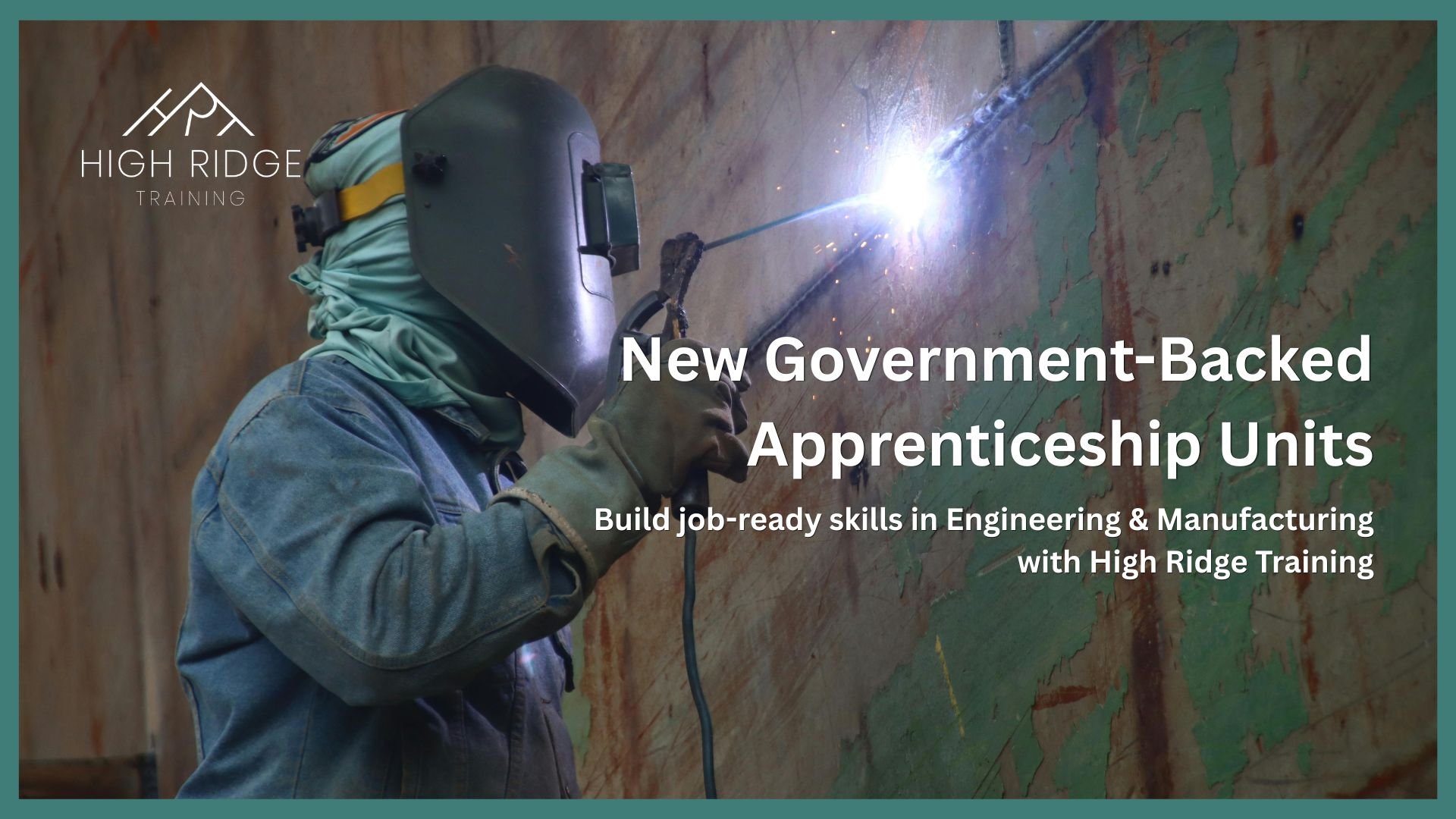
The UK’s industrial workforce is changing faster than ever.
From electrification and automation to advanced manufacturing and sustainable energy, employers across engineering, construction, manufacturing, and clean technology are facing one common challenge:
Finding people with the right skills, fast.
To address these critical skills shortages, the UK government has introduced a new training model called apprenticeship units, launching from April 2026 across England.
At High Ridge Training, we’re proud to support employers and learners in accessing these new government-backed programmes designed to deliver targeted, practical skills in high-demand sectors.
But what exactly are apprenticeship units, who are they for, and how could they support your career or business growth?
This guide answers the most common questions.
What Are Apprenticeship Units?
Apprenticeship units are short, flexible training programmes created by the UK government to help employers upskill existing staff in areas where skills shortages are impacting productivity.
Unlike traditional apprenticeships, these programmes are not designed for someone entering a completely new career.
Instead, they are built for:
Employees who need new technical skills
Experienced staff adapting to changing technologies
Businesses investing in workforce development
Teams preparing for industry expansion
According to official government guidance, apprenticeship units are available to learners aged 19 and over who are already employed.
This makes them ideal for businesses looking to future-proof their workforce without committing employees to long-term qualification programmes.
Apprenticeship Unit vs Traditional Apprenticeship: What’s the Difference?
This is one of the most common questions learners and employers ask.
| Apprenticeship Units | Traditional Apprenticeships |
|---|---|
| Designed for existing employees | Can support new hires or career starters |
| Focused on specific skill gaps | Full occupational competence |
| 30 to 140 delivery hours | Typically 12 months or longer |
| Delivered over 1 to 16 weeks | Long-term structured programme |
| No standalone English or maths requirements | May include English and maths |
Government guidance confirms apprenticeship units can be delivered over one to sixteen weeks, depending on the programme.
Who Is Eligible?
To qualify, learners generally need to:
Be 19 or Older
These programmes are specifically designed for adult learners.
Be Currently Employed
You must already be working in a relevant role.
Have a Genuine Skills Gap
Employers and providers complete an initial assessment to identify training needs.
Meet Residency Requirements
As with funded apprenticeships, eligibility rules apply.
A common misconception is that apprenticeship units are for job seekers. They are not. If you’re looking to start a completely new occupation, a full apprenticeship may be more appropriate.
How Is Funding Structured?
One of the biggest benefits of apprenticeship units is government support.
| For non-levy employers | For levy-paying employers |
|---|---|
| Training is fully funded by government. |
Levy funds can now be used for apprenticeship units for the first time. If levy funds are exhausted:
|
New Engineering and Manufacturing Apprenticeship Units Available in 2026
The first wave aligns with the UK Industrial Strategy. At High Ridge Training, we’re excited about four specialist units with strong long-term career value.
1. Battery Manufacturing Apprenticeship
Battery manufacturing is one of the fastest-growing sectors in the UK, driven by the rise of electric vehicles (EVs), renewable energy storage, and sustainable technology initiatives.
This unit introduces learners to the complete battery production lifecycle, including:
What You Will Learn:
Fundamentals of battery cell production and assembly
Understanding lithium-ion and modern battery technologies
Safe handling of materials and components
Quality control testing and inspection procedures
Cleanroom and controlled manufacturing environments
Sustainability practices in energy storage production
Career Benefits:
After completing this unit, learners may progress into roles such as:
production operative
battery technician
quality inspection assistant
manufacturing technician
Why it matters
With giga factories and EV investment increasing across the UK, battery manufacturing skills are expected to remain in high demand.
2. Electrical Fitting and Assembly Apprenticeship
Electrical fitting is a core skill across engineering, construction, and industrial maintenance. This apprenticeship unit focuses on building strong technical competence in electrical systems and assemblies.
What You Will Learn:
Electrical wiring, circuits, and component installation
Reading and interpreting technical electrical diagrams
Safe use of electrical tools and testing equipment
Fault diagnosis and troubleshooting techniques
Compliance with electrical safety regulations
Assembly of electrical systems in industrial settings
Typical progression routes:
Electrical assembly operative
Junior technician
Maintenance support engineer
Government funding for this unit is currently set at £1,650 for 70 delivery hours.
3. Mechanical Fitting and Assembly Apprenticeship
Mechanical fitting remains one of the most essential skill areas in manufacturing and engineering environments. This unit focuses on precision, technical understanding, and hands-on assembly work.
What You Will Learn:
Assembly and fitting of mechanical components and systems
Use of hand tools, measuring instruments, and machinery
Interpretation of engineering drawings and blueprints
Maintenance and servicing of mechanical systems
Alignment, calibration, and testing procedures
Workplace health and safety standards
Career outcomes
Learners often progress into:
Mechanical fitter
Production technician
Maintenance engineer
Engineering operative
4. Welding – Mechanised Apprenticeship
Welding is a highly specialised and in-demand skill across manufacturing, construction, shipbuilding, and heavy engineering industries.
This unit focuses on mechanised welding techniques used in modern production environments.
What You Will Learn:
Operation of mechanised welding equipment
Advanced welding techniques for precision fabrication
Material preparation and joint design
Quality assurance and inspection processes
Understanding welding codes and standards
Health and safety in welding environments
Career Benefits:
This qualification leads to careers as a welding technician, fabrication operative, or production welder.
Skilled welders are consistently in demand across UK infrastructure and manufacturing projects, making this a highly secure and well-paid career pathway.
Funding and duration
This unit includes 90 delivery hours with government funding of £2,100.
How Are Learners Assessed?
Another common question:
“Do I have to sit exams?”
Not in the traditional sense.
Learners complete a skills test delivered by the training provider, which is then validated by the employer to confirm competence.
This ensures training remains practical, relevant, and workplace-focused.
Can Apprenticeship Units Lead to Further Qualifications?
Yes. One of the biggest advantages is progression.
If a learner later moves onto a full apprenticeship, completed units may count as prior learning, potentially reducing the overall programme duration.
That means today’s short-term upskilling could become tomorrow’s long-term career development pathway.
Real-Life Example
Imagine an assembly technician working in manufacturing for three years.
Their employer is introducing EV production lines.
Instead of hiring externally, the business enrols them onto a Battery Manufacturing apprenticeship unit.
Within a matter of weeks, they gain:
specialist EV manufacturing knowledge
hands-on production skills
recognised training
improved promotion prospects
That’s exactly what apprenticeship units are designed to achieve.
How These Apprenticeships Support Career Growth
Each of these apprenticeship units is designed not only to build technical knowledge but also to create clear career progression routes.
By completing these programmes, learners can:
Start Strong in Industry
Gain entry-level roles with real responsibilities and hands-on experience from day one.
Progress into Skilled Roles
Move into technician, specialist, or supervisory positions with experience and further training.
Continue Professional Development
Progress into higher apprenticeships, NVQs, or specialised engineering qualifications.
Increase Employability
Develop transferable skills that are valued across multiple industries, including manufacturing, energy, logistics, and engineering.
Why Choose High Ridge Training?
At High Ridge Training, we focus on delivering training that leads to real employment outcomes.
Our programmes are designed with:
Industry-experienced trainers
Employer-led delivery
Practical workshop-based learning
Strong employer partnerships
Government-approved apprenticeship frameworks
Career-focused progression pathways
We ensure every learner gains not just a qualification, but the confidence and capability to succeed in the workplace.
The introduction of these new government-backed apprenticeship units marks an important step in strengthening the UK workforce. Whether you are starting your career or looking to upskill, these programmes provide a direct route into high-demand industries with real growth potential.
At High Ridge Training, we are proud to support learners in building meaningful careers through practical, industry-relevant training.
If you are ready to take the next step towards a skilled and secure future, these apprenticeship pathways are an excellent place to begin.
